 Bolod Tours
Experience theAuthentic Mongolia
Authentic Mongolia
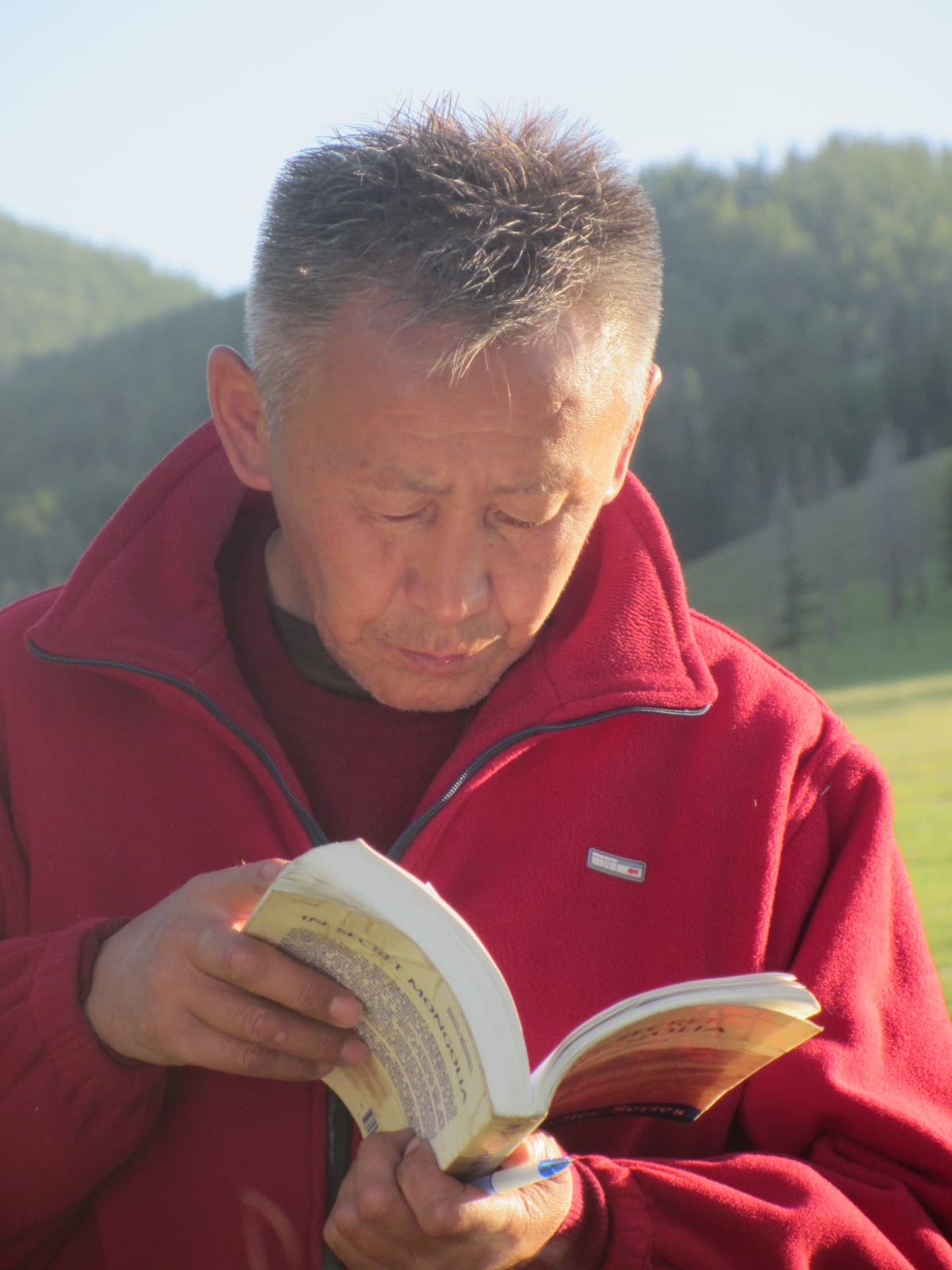
MEET
BOLOD.
"I'm Bolod, an experienced Mongol guide and a travel arranger who speaks Italian, English, Russian and French. "
In our the Bolod Guesthouse which is on Booking.com, you'll find 74 chronological Albums documenting all 711 trips to nomadic Mongolia that we've arranged since 1993. We invite you to stay and travel with us to experience the authentic Mongolia.
I grew up in a small village in far-eastern Mongolia, experiencing both the joys and hardships of rural life. In my childhood, I spent a lot of time on horseback too. Although I live in the city for a long time, I still feel like a person of rural Mongolia.
///He is often referred to as the "Tank Guy" due to his history of organizing unique, adventurous trips. His tours emphasize authentic, eco-friendly, and cultural immersion, rather than standard, commercial tourist experiences.Services: He organizes tours, arranges travel, and offers guesthouse accommodation in Ulaanbaatar
///In the capital, Ulanbataar, I'd recommend Bolod's Guesthouse. Bolod is an awesome little chap who can speak Italian, English, Russian as well as his native Mongolian. He can also arrange the coolest sounding tours at a decent price (Tank driving for example, $20 per km). You get free use of his computer too, and it's in a good location right in the middle of town.///
R: Some tourists called me as the "Tank Guy" because I was arranging driving tanks, shooting ranges and firing RPGs.
I'm not arranging these "military" trips" anymore!!!
I believe that unspoiled nature can sustain us for thousands of years, whereas uncontrolled mining may only last another 50-60.
WhatsApp: +9769919207
WhatsApp: +97694922407
Bolod Guesthouse and Tours has been recommended:
Lonely Planet's "Mongolia" guidebook of 2001/139/, 2005/p.69, 72/, and 2006/p.263/.
Petite fute, 2008-2009/p.86/
Short Trips
See moreTrips
See more Day Trips
no.01 / Trip to Chingis Khaan Equestrian Statue and Turtle Rock
 Day Trips
no.02 / Day Trip Eastwards
 Day Trips
no.03 / Day Trip Westwards
 Day Trips
no.04 / Day Trip Southwards
 2-Day Trips
no.05 / 2-Day Trip Eastwards
 2-Day Trips
no.06 / 2-Day Trip Westwards
 2-Day Trips
no.07 / 2-Day Trip Southwards
 3-Day Trips
no.08 / 3-Day Trip Eastwards
 3-Day Trips
no.09 / 3-Day Trip Westwards
 3-Day Trips
no.10 / 3-Day Trip Southwards
 Trips to East
no.12 / Eastwards: mountains, forests, lakes, rivers, nomads
 Trips to Central West
no.13 / Trip to White Lake
 Trips to Central West
no.14 / Hustai N.P-Harkhorin -Harbukh Fortress
 Trips to Central West
no.15 / 5-Day Trip to Orkhon Valley/Ulaan waterfall-Tuvkhun Monastery/.
 Gobi-Central West
no.16 / South Gobi-Orkhon Valley-Ulaan Waterfall
 Trips to Central West
no.17 / Middle Gobi-Central West
 Trips to Gobi
no.18 / Trip to Gobi
 Trips to Central West
no.19 / Gobi-Ikh Bogd Mountain -8 Lakes-Har Khorin
 Trips to East
no.20 / Trip to Eastern Mongolia
 Trips to Central West
no.21 / Trip to Gobi and Huvsgul Lake
 Trips to Central West
no.22 / Trip to western Mongolia and Huvsgul Lake
 Trip to Far West
no. 23 / UB-Hovd-Dalan Zadgad-UB
 Trip to Far West
no.24 / Hovd-Ulaan Baatar
 Trips to Central West
no.25 / Ar Hangai and Huvsgul Lake
Change of nature
winter
Temperature
-20°C / -40°C
Highlights
- •Tsagaan Sar — Mongolian Lunar New Year
- •Experience nomadic winter camp life
- •Camel trekking across Gobi snow dunes
- •Ice fishing on frozen lakes
autumn
Temperature
5°C / 15°C
Highlights
- •Ulgii Eagle Festival — golden autumn celebration
- •Witness nomads migrating to winter camps
- •Golden forests of Altai and Khangai
- •Prime season for hunting and fishing
spring
Temperature
0°C / 15°C
Highlights
- •Lambing season — newborn animals across the steppe
- •Wildflower blooms and birdwatching
- •Nomads moving to spring pastures
- •Nature awakening with fresh, crisp air
summer
Temperature
20°C / 30°C
Highlights
- •Naadam — wrestling, horse racing & archery festival
- •Swimming and trekking at Lake Khövsgöl
- •Horse riding through Khangai's green mountains
- •Stargazing under the Gobi desert night sky
Latest Stories
https://jerous.org/2015/06/23/mongolia:p4-ub2
... Returning to our hostel, we encountered another bunch of Flemish speaking people - it was the other Joker group. While palavering, Bolod came sadfaced to us, and said he didn't have enough tickets for the Naadam's opening ceremony, but he would try to take care of it!...
Travel photo reportage: Northern Mongolia (part II)
Travel photo reportage: Northern Mongolia (part II)Published on:14 September 2017 Written by:Marco Maculotti Comments: 2(follows from part I)«Land of bare mountains, of plains heated by the sun and frozen by the cold, where the diseases of cattle and men, plague, anthrax and smallpox reign; land of hot springs and mountain passes guarded by demons, of sacred lakes teeming with fish; land of wolves, rare species of deer and mouflons, of millions of marmots, horses, donkeys and wild camels, all animals that have never known the bridle, land of ferocious dogs and birds of prey that devour the corpses that that people abandon in the plains: such is Mongolia.Homeland of people who are disappearing and watch the calcined bones of their ancestors whiten in the sun, people who conquered China, Siam, northern India and Russia, and whose chests collided with the iron spears of the Polish knights who were defending then Christianity from the invasion of wild and nomadic Asia: such is Mongolia.A land of great natural wealth that also produces nothing, needs everything, and seems to suffer from all the evils and cataclysms of the world: such is Mongolia. "(FA Ossendowski, "Beasts, men, gods", chap. XVII, "Mysterious Mongolia")As some of you readers probably already know, the month of August saw me on a trip to Mongolia especially in the northern region bordering Siberia - during which, with the support of the Bolod guide (http://www.bolodtours.com/) I had the opportunity to visit the most significant places, to learn the habits and customs of the nomadic population and to collect material for a series of articles that will be published on AXIS mundi as well as on other publications. Pending the publications in question, I decided to publish a report photographic (divided into two parts) of the journey, accompanied by short notes, with the aim of bringing the reader closer to the discovery of the Mongolia first of all from a visual point of view.READ MORE The "Little People" in Southeastern Native American folklore[Click on the photos to view them in full screen]4 - Bulgan / Selenghe.The provinces of Bulgan and Selenghe are characterized by immense valleys interspersed with rivers (the most famous is precisely the Selenghe river, which gives its name to the territory it crosses), conifer groves, now inactive craters, and the usual, omnipresent , egg shamanists, on whose mounds of stones the faithful leave the most disparate offerings (money, personal items, sacred icons, horse skulls, crutches). At the Buddhist monastery of Bulgan, whose foundation dates back to the XNUMXth century, Ferdinand A. Ossendowski first met the semi-legendary Baron Roman Nicolaus von Ungern-Sternberg. On its ceiling you can admire the symbol of Kalachakra, a term that in Buddhism Vajrayana indicates the samsaric wheel of time, time cycles, deaths and rebirths. Today in this place the very young lamas play carefree with a puppy dog: here sacred and profane intersect in a palpable way.Shamanic Ovoo.Shamanic Ovoo.Shamanic Ovoo.Bulgan Monastery.Bulgan Monastery.Bulgan Monastery.Bolod.Buddhist stupa.Inactive crater in the Selenghe region.Inactive crater in the Selenghe region.Selenghe River.Selenge.Sheep flock in the Selenghe region.One of the sacred mountains of the region.5 Khövsgol.Lake Khövsgöl is the second largest in the country by area after UVS Nuur, but the first by volume due to its depth (about 140m compared to only 12 by UVS). It contains about 70% of the country's fresh water, which is why the natives refer to it as the "Sea of Mongolia" and consider it sacred, just as Siberians consider sacred the "twin" lake Baikal, the largest in the world. whole Asia. Indeed, already in the Khövsgöl region you can breathe the air of the Siberian taiga: in addition to the typically alpine lakes, you will come across groves of larch and birch trees, rivulets and streams. On the shores of the main lake and on the wooded paths you can meet, in addition to the horses that are raised by the natives living in colorful wooden houses, even substantial herds of yaks.Traditional logo with horse.Gher on the Khovsghol lake.Khovsghol lake.Bolod in front of a traditional cottage.It gave.A local buriate cuts the wood.Buriate woman.Ger.Khovsghol lake.Dava watches the incoming storm.Bolod.Khovsghol lake.Khovsghol lake.Nomad with horses.Khovsghol lake.Cow in the Khovsghol lake.Mongolian with horse.Mongolian with horses.Mongolian with horses.Yak.Horses in front of gher and traditional houses.6 - The Tsaatan: reindeer-men.In the extreme north of Mongolia, on the border with Siberia, live the last 230 members of the Tsaatan tribe (lit .: "reindeer men"), an ancient ethnic group of Turkish-Altaic origin with their own tradition and language that lives in symbiosis with the their own reindeer, from which they get everything they need for sustenance. The Soviet regime in the 30s tried in vain to "flush out" them and persuade them to abandon their traditional life, with the illusion of a job and a sedentary life. They are very attached to their shamanic traditions and live in tents similar to those of Native Americans, testifying to the ancient migration through the Bering Strait.READ MORE The Eternal Man and the Cosmic CyclesReindeer-men.Chute.The author with a Tsaagan and two reindeer.Chute.Reindeer-men.Reindeer-men.Chute.Reindeer-men.Reindeer-men.Reindeer-men.7 - Tsagaan Nuur: the White Lake.Tsagaan Nuur is the last village of wooden shacks scattered in the steppe accessible by jeep before reaching the vast taiga, on the border with Russia, inhabited by "reindeer-men". To give it this name (lit .: «White Lake») is the glacial water mirror that represents the greatest naturalistic attraction of the area in question, on whose calm waters you can spot flocks of swans. The surrounding area is entirely volcanic: from the semi-artificial pyramidal structures of magmatic rock that line the lake to the inactive crater in its surroundings it almost seems to be in Iceland more than in Asia.Traditional steppe houses.Plateau.Completed cottage and cottage under construction.Buddhist stupa.Torrent.Ford of a river.Tsagaan Nuur: the White Lake.Tsagaan Nuur: the White Lake.Tsagaan Nuur: the White Lake.Tsagaan Nuur: the White Lake.Tsagaan Nuur: the White Lake.Tsagaan Nuur: the White Lake.Underground cave.Colonel Dava.Ascent to the extinct crater.Crater extinct.Northern landscape.Volcanic pond.River in a northern landscape.Bolod.8 - Stele of the Deer, ancient tombs, Uighur fortresses.The name of the Mongolian monoliths known as the "Stele of the Deer" derives from the fact that on their surface, in addition to lunisolar symbols and inscriptions in ancient languages, deer in flight have been carved. Archaeologists have unearthed over 500 similarly recorded stones across Mongolia. It is believed that they were built by the ancient populations who lived in these steppes, the Scythians and the Cimmerians, in the Bronze Age (about 1000 BC). The Steles in the photos are located in the Arkhangai province. The Bronze Age civilizations also built ancient mound tombs, consisting of a pile of stones stacked one on top of the other and sometimes surrounded by a rectangular perimeter which was also stony. The tradition and use of burial sites was then continued by more recent populations, including the Huns. Of more recent age (VII - X century AD) are instead the fortresses built by the Uighurs, which denote a very peculiar architectural style.Ancient tomb.Northern highlands.Ancient tomb.Stele of the Deer.Stele of the Deer.Ancient tomb.Ancient tomb.Stele of the Deer with inscriptions in ancient Mongolian.A complex of Stele del Cervo.Stele of the Deer.A complex of Stele del Cervo.Bolod next to a Stele of the Deer.A complex of Stele del Cervo.A complex of Stele del Cervo.Stele of the Deer.Stele of the Deer with inscriptions in ancient Mongolian.Ancient Uighur fortress.Ancient Uighur fortress.Ancient Uighur fortress.Ancient Uighur fortress.Ancient Uighur fortress.Ancient Uighur fortress.Ancient Uighur fortress.9 North-central Mongolia.Just outside Ulan Bator, near a egg, stands a statue of a well-known shaman, who died in a road accident a few meters away, a few years ago. It was erected by his pupils and by the people he had helped and healed with his art in life: they see in his tragic fate a kind of sacrifice, as after his death many of them experienced an unexpected improvement in their conditions of health or a sudden increase in pdiscover shamanic powers. People leave votive offerings under the statue, including bottles of vodka (in Mongolian shamanism this alcoholic drink has great relevance) and a wooden statuette representing a wolf, an animal that, due to its propensity to live on the margins of society, fully reflects the shaman's approach to existence. At the National History Museum of Ulan Bator you can admire, in addition to petroglyphs dating back to the Paleolithic and late Neolithic times, traditional costumes dating back to various historical periods and other characteristic Mongolian objects (ritual masks, board games, musical instruments).Central highlands.Flooded steppe.Flooded steppe.Flooded steppe.Mongolian carries horses.Nomad in front of his gher.Mongolian steppe.Mongolian steppe.Shamanic Ovoo.Autochthonous in front of a shamanic ovoo.Shamanic Ovoo.Shamanic Ovoo.Bolod in the backyard of a shaman.Shaman statue.Wooden statuette depicting a wolf.Shaman statue.Hills around Ulan Bator.Ulan Bator Museum.Ulan Bator Museum.Ulan Bator Museum.Ulan Bator Museum.Ulan Bator Museum.Ulan Bator Museum.Ulan Bator Museum.Ulan Bator Museum.
Moorken Travel
MoorkenstravelSunday, 11 October 2015Mongolia: road trip part 12 vans, 2 drivers, 1 cook, 1 kid, 1 guide, 6 tents, loads of food and water and 7 adventurous Belgians. All on the Mongolian road for 2 weeks!Day 1: our guide Bolod has a lot to tell. While he sometimes repeats himself, the stories are fascinating and his English is great. His website: http://www.bolodtours.com/ We experience the 'road' for the first time, a dirtroad filled with potholes, but nothing our trusty Russian vans cannot handle. During our first stop, we see a few things that will appear a lot during the entire trip: hills with an ovoo on top, herds of goats & sheeps, and grasshoppers everywhere. Another stop is Khustain Nuruu National Park, home to the Przewalski horse. We can only spot them in the distance, but it's a great feeling to see them running around freely. We finally make camp at a lovely meadow between a river and some mountains with great views from the top!Day 2: our first job of the day is helping a farmer to load a fleeing bull. A bit later we stop at a camel farmer and have some sharp tasting camel milk. After crossing many beautiful landscapes, the most impressive is a strip of desert, the Mongol Els. We set up camp close by but our dinner is interrupted by a sand storm! Luckily our tents are secure so we only suffer some plugged nostrils.Day 3: after shaking all the sand out of our tents we continue. At another family we get more traditional products: dried cheese and fermented horse milk (airag or kumis) two things I will never get fond of. Our drives love the stuff, almost as much as they like dance music, which is played all the time in the van! We set camp at lake Ögil Nuur were we have a refreshing swim and spend the afternoon learning to steer a massive herd of goats.Day 4: more roads and gers. We set camp near a fast flowing river and play a Belgium vs Mongolia soccer match. At night, some of us are awoken by horsemen riding trough our camp and hitting tents. They leave without saying a word so our guide suspects bandits. Turns out it were just some curious local farmers who had too much vodka.Day 5: we stop in Tsetserleg to get supplies. It's a moderate city nicely located in between the mountains. It's very hot though, so we escape to a temple/museum. Most temples are Buddhist and have a Chinese style. We leave the city and eventually arrive at the family the who will supply our horses. Because it's late, we just go for a quick test run. Some of us never rode a horse but the mounting goes reasonably well. I had some horse riding lessons before, so they let me ride freely, and I can even help to herd the goats back to the pen, super cool! And also a great way to end day
IN BOLOD WE TRUST
maanantai 16. heinäkuuta 2012In Bolod we trustAfter a days wait at the Russia-Mongolia -border we finally got to continue to Mongolia, the land of the Chinggis Khan and the humble nomads. It really says a lot about a country, that the best thing ever happened to it was Stalin's communism and that it still seeks mental guidance from a guy who lived in the 10th century.Basically the capital Ulaanbaatar was an over-grown tent-village of about 1,2 million people (2008). The man sitting on the ground was Mr. Bolod. He was our beloved tour-guide who also offered one of his apartments for us to stay in. Unfortunately one of our group-member took the only set of keys for the apartment with him back to Finland, so Bolod's accommodation-business got messed up for the season.Bolod showed us a set of bizarre sights, such as this old Mongolian army barrack. No idea, why this was relevant. Although, it's quite funny and sad at the same time, that there appears to be a person living in front of the abandoned barrack in a yurt.A spectacular show on how to wool a lamb was displayed to us western city-people by the nomad's. Very exciting stuff! The gentleman on the right is Colonel Friday, a fundamental communist with a very short fuse. He enforced obsessively that we'd eat every dairy meal and snack that was offered us by the nomad people. While gagging down some yoghurt-dumplings one of our group-member was able to distract the Colonel by putting a peace of paper to the nomad-stove. That was a great insult for the nomad culture, because the stove was only allowed to be heated up with sacred cow-manure. During the distraction, we were able to get rid some of the force-feeded food by throwing it under the yurt's rug.A typical nomad dish looked like this. Looks pretty delicious right? Well, when you eat this stuff 365 days a year three times a day, like the nomad's for sure eat, you might consider ordering a pizza.At this corner of the world people tend to have some weird habits. Whereas chinese people burb and fart a lot to improve their digestion, mongolian people spit to improve their... well... they just spit. The habits make them fun people to hang-out with, especially in closed compartments such as trains or cars. In Ulaanbaatar we spent an evening at the Chinggis Beer Club. We encountered a serious liquidity problem when the electricity went off at the city and no card payment was possible. We had no cash and the bill was 123.800 tökröks.Luckily we had a solution for the problem. We just kept on ordering more drinks until the electricity would come back on and a card payment would be possible again.Also in Mongolia the back-seat boys were sleepy.There was a horrendous silver statue of the Chinggis Khan standing in the middle of the desert. It was quite obvious that it was built there just that Mongolia would have something for the tourists in the middle of the desert. We didn't fall for that touristic crap and turned our backs on the stupid thing. At the nomad-camp Bolod told us, that there might be a shaman sitting at the top of the nearby hill, and that the shaman might wanna meet us. Bolod encouraged us to climb to the hill and see for ourselves. Well we climbed and there was no shaman, but at least we got to do some top-class power-fisting at the top.At the edge of the Gobi-desert. We crossed the Gobi-desert at night time and decided it would be a good idea to leave the cabin's window open for the night, because it was so hot. During the night, there was a sand storm raging in our cabin, but everybody were too tired to close the window.Can you spot two of our former friends from this decorative Mongolian restaurant cabin? Yes, you're right, there is Jens and Borreliosis-Peter. We saw them again in Ulaanbaatar, and especially Jens was surprised, not happy, that we're alive after our epic travelling in Russia. Don't be fooled by the sarcastic tone of this Mongolia-post, because it really is a wonder, that there are living, breathing and spitting people in this isolated part of the world. For that, Mongolia deserves some god damn respect.maanantai 16. heinäkuuta 2012In Bolod we trustAfter a days wait at the Russia-Mongolia -border we finally got to continue to Mongolia, the land of the Chinggis Khan and the humble nomads. It really says a lot about a country, that the best thing ever happened to it was Stalin's communism and that it still seeks mental guidance from a guy who lived in the 10th century.Basically the capital Ulaanbaatar was an over-grown tent-village of about 1,2 million people (2008).The man sitting on the ground was Mr. Bolod. He was our beloved tour-guide who also offered one of his apartments for us to stay in. Unfortunately one of our group-member took the only set of keys for the apartment with him back to Finland, so Bolod's accommodation-business got messed up for the season.Bolod showed us a set of bizarre sights, such as this old Mongolian army barrack. No idea, why this was relevant. Although, it's quite funny and sad at the same time, that there appears to be a person living in front of the abandoned barrack in a yurt.A spectacular show on how to wool a lamb was displayed to us western city-people by the nomad's. Very exciting stuff!The gentleman on the right is Colonel Friday, a fundamental communist with a very short fuse. He enforced obsessively that we'd eat every dairy meal and snack that was offered us by the nomad people. While gagging down some yoghurt-dumplings one of our group-member was able to distract the Colonel by putting a peace of paper to the nomad-stove. That was a great insult for the nomad culture, because the stove was only allowed to be heated up with sacred cow-manure. During the distraction, we were able to get rid some of the force-feeded food by throwing it under the yurt's rug.A typical nomad dish looked like this. Looks pretty delicious right? Well, when you eat this stuff 365 days a year three times a day, like the nomad's for sure eat, you might consider ordering a pizza.At this corner of the world people tend to have some weird habits. Whereas chinese people burb and fart a lot to improve their digestion, mongolian people spit to improve their... well... they just spit. The habits make them fun people to hang-out with, especially in closed compartments such as trains or cars.In Ulaanbaatar we spent an evening at the Chinggis Beer Club. We encountered a serious liquidity problem when the electricity went off at the city and no card payment was possible. We had no cash and the bill was 123.800 tökröks.Luckily we had a solution for the problem. We just kept on ordering more drinks until the electricity would come back on and a card payment would be possible again.Also in Mongolia the back-seat boys were sleepy.There was a horrendous silver statue of the Chinggis Khan standing in the middle of the desert. It was quite obvious that it was built there just that Mongolia would have something for the tourists in the middle of the desert. We didn't fall for that touristic crap and turned our backs on the stupid thing.At the nomad-camp Bolod told us, that there might be a shaman sitting at the top of the nearby hill, and that the shaman might wanna meet us. Bolod encouraged us to climb to the hill and see for ourselves. Well we climbed and there was no shaman, but at least we got to do some top-class power-fisting at the top.At the edge of the Gobi-desert. We crossed the Gobi-desert at night time and decided it would be a good idea to leave the cabin's window open for the night, because it was so hot. During the night, there was a sand storm raging in our cabin, but everybody were too tired to close the window.Can you spot two of our former friends from this decorative Mongolian restaurant cabin? Yes, you're right, there is Jens and Borreliosis-Peter. We saw them again in Ulaanbaatar, and especially Jens was surprised, not happy, that we're alive after our epic travelling in Russia.Don't be fooled by the sarcastic tone of this Mongolia-post, because it really is a wonder, that there are living, breathing and spitting people in this isolated part of the world. For that, Mongolia deserves some god damn respect.